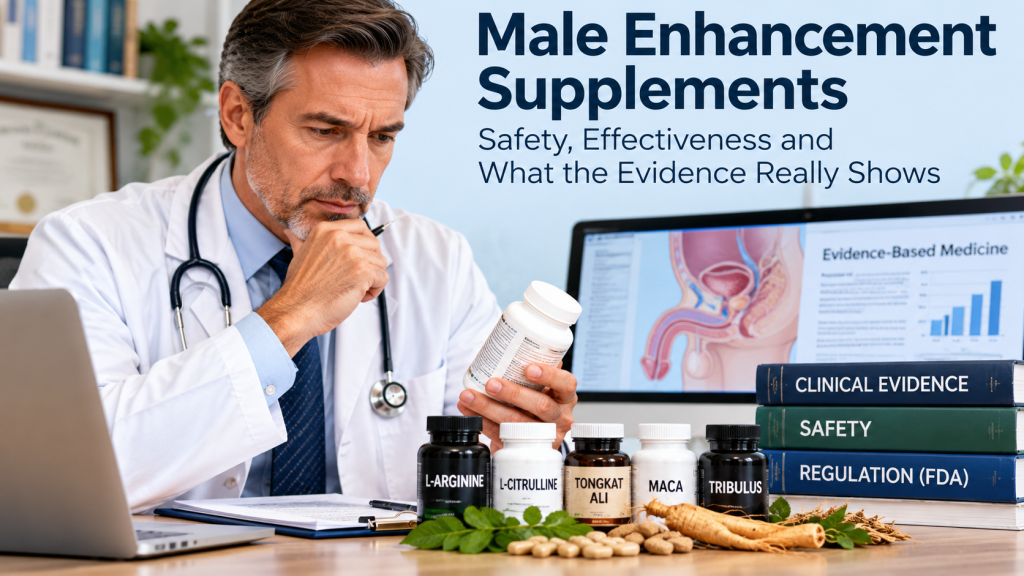
Male Enhancement Supplements are among the most heavily advertised products in men’s health, often promising improved sexual performance, stronger erections, and increased vitality. In my clinical practice, patients frequently ask whether these products actually work and whether they are safe.
The effectiveness of male enhancement supplements depends on their ingredients, the quality of scientific evidence, and potential safety risks. Unlike prescription medications, dietary supplements are not approved by the FDA for safety and effectiveness before marketing. This article examines how these products are regulated, identifies important safety concerns, and explains how to evaluate their claims using scientific evidence. The information is intended for general education and should not replace personalized medical advice.
Male Enhancement Supplements: How They Are Regulated
In the United States, the FDA does not approve dietary supplements for safety or effectiveness before they’re sold, and it doesn’t approve their labeling either. Under the Dietary Supplement Health and Education Act (DSHEA), manufacturers and marketers are responsible for ensuring their products are safe and lawful and that their labels are truthful and not misleading. The FDA’s role mainly begins after a product is on the market.
The regulation of male enhancement supplements is particularly important because some products marketed for sexual performance have been found to contain undisclosed prescription drug ingredients, creating potentially serious health risks.
Supplement makers may make “structure/function” claims, such as supporting normal function, if they can substantiate them. The label must then say: “This statement has not been evaluated by the Food and Drug Administration. This product is not intended to diagnose, treat, cure, or prevent any disease.” Products intended to treat a disease are regulated as drugs, even if they’re sold as supplements.
What this means for you: a product on a shelf or website is not proof that it works or that it has been tested for safety the way a prescription medicine has.
The hidden-drug problem
The FDA has repeatedly found “sexual enhancement” products, sold as “all natural” supplements, containing undeclared prescription drug ingredients, including sildenafil (the active ingredient in Viagra) and tadalafil (the active ingredient in Cialis). The FDA warns that these hidden drugs can interact with nitrates, such as nitroglycerin, and lower blood pressure to dangerous levels. Many men who take nitrates also have diabetes, high blood pressure, high cholesterol or heart disease. The FDA has also said it cannot test every product on the market.
That doesn’t mean every supplement is tainted. It does mean you shouldn’t buy products from unknown sellers, and that a product’s “natural” label isn’t a safety guarantee. You can report side effects to the FDA’s MedWatch program.
Why erectile problems deserve a real evaluation first
Erectile dysfunction can come from blood vessel disease, diabetes, medicines, low testosterone, sleep apnea, stress and other causes, and it can be an early sign of heart disease. A supplement can’t tell you which cause applies to you. A clinician can, and effective, evidence-based prescription treatments exist.
Sleep quality is another important consideration when evaluating erectile difficulties. Poor sleep and untreated sleep apnea may contribute to sexual health problems. Learn more about the relationship among sleep, testosterone, cardiovascular health, and sexual function in our article, Sleep and Men’s Health.
How to judge a supplement’s evidence
Ask these questions about any product:
- Is there a human trial? Lab or animal studies don’t show that a product works in men.
- Was it randomized and placebo-controlled? Without a placebo group, improvement may come from expectation or time.
- How many men, and for how long? Small, short studies can’t show lasting benefit or safety.
- Who paid for it and who did it? Studies paid for by the manufacturer need extra caution. Look for a funding and competing-interests statement.
- Was it published in a peer-reviewed journal, and was it about the actual product? A study of one ingredient doesn’t prove that a blend of many ingredients works.
- Do the claims match the results? Be skeptical of exact percentages and “clinically proven” without a citation you can read.
- What are the ingredients and doses, and do they interact with your medicines? Some common herbs affect bleeding, blood pressure or heart medicines. Bring the label to your clinician or pharmacist.
When to talk to a clinician first
- You take nitrates, blood thinners, blood pressure or heart medicines
- You have heart disease, diabetes, kidney or liver disease
- Erectile problems are new, or you also have chest pain, shortness of breath or dizziness
Bottom line
Male enhancement supplements should be evaluated carefully for credible human clinical evidence, ingredient safety, and potential interactions with prescription medications. Some supplements may have modest evidence, many have little, and the category has a documented problem with hidden drugs. A careful approach is to get evaluated, ask for the evidence, and tell your clinician exactly what you take. Later articles on this site look at specific products one at a time, and say plainly when evidence is limited.
Educational only. This site doesn’t provide medical advice, diagnosis or treatment, and it isn’t a substitute for care from your own clinician.